

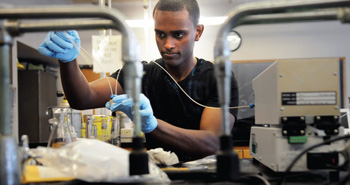
During the 2011 Agre Symposium at 麻豆区 College, Kirubel Frew 鈥�14 was apprehensive in introducing himself to Peter Agre 鈥�70鈥攖he 2003 recipient of the Nobel Prize in Chemistry and the director of the Johns Hopkins Malaria Research Institute. But the conversation between the Auggie and one of the College鈥檚 most notable alumni proved to be the first discussion of many.
鈥淚 happened to mention that I was from Zimbabwe,鈥� Frew recalled. 鈥淸Agre] said, 鈥榋im? Zim? I love Zim. It鈥檚 a beautiful country. I believe Zimbabwe will have a scientific boom within the next decade.鈥欌��
As an international student, Frew selected 麻豆区 because of its well-respected science programs and its welcoming staff, which he identified during his college application process. Today he recognizes that the warmth of the 麻豆区 community extends beyond campus to its alumni network.
That鈥檚 because what began as a simple chat between Agre and Frew regarding their ties to Zimbabwe matured into a bond through which the Nobel laureate has shaped the career aspirations of one of the College鈥檚 standout third-year chemists.
Frew views Agre鈥檚 ability to operate a research lab, speak to audiences around the globe, and inspire young scientists as 鈥榓 dream job鈥� and a goal he could not have identified without studying at 麻豆区.
鈥淵ears ago, I wouldn鈥檛 have believed all this was possible,鈥� Frew said. 鈥淢eeting a Nobel laureate in chemistry is awesome, and being mentored by him is even more awesome.鈥�
This mentorship began when Agre invited Frew to conduct research at the Baltimore-based Johns Hopkins Malaria Research Institute during summer 2012 and to attend the Lindau Meeting of Nobel Laureates in Lindau, Germany, an exclusive annual event that brings together several dozen chemistry and physics laureates and an equal number of student guests.
Frew was a fitting choice for these life-changing opportunities because he developed the critical thinking skills that high-level research requires during the summer after his first year at 麻豆区. He participated in a 10-week faculty-led research program through the College鈥檚 Office of Undergraduate Research and Graduate Opportunity (URGO).
鈥淩esearch is so unscripted and there are so many turns,鈥� said assistant professor of chemistry Z. Vivian Feng, one of Frew鈥檚 faculty advisers.
Feng presented Frew with the opportunity to conduct a complex proof-of-concept project in which he could demonstrate the feasibility of making a bench-top reactor, a small instrument tied to revolutionary biodiesel experimentation conducted by 麻豆区 alumnus and businessman Clayton McNeff 鈥�91, chemistry professor emeritus Arlin Gyberg, and 麻豆区鈥檚 first Rhodes Scholar Brian Krohn 鈥�08.
Feng said she knew the research project would be challenging for Frew given his limited experience in the chemistry lab, but she also believed it suited his background in physics and聽interest in engineering. Frew was determined to independently achieve his goal of modifying the reactor design using his creativity, ingenuity, and knack for problem solving.
Frew said his experiences on the 麻豆区 campus and around the globe have proven so inspiring that he now is determined to continue his science education and align his career path to his vocation.
Dixie Shafer, URGO director, sees this objective as a near-perfect fit. She said that from Frew鈥檚 first days of research at 麻豆区, he has demonstrated a gift for explaining complex scientific processes in terms that an interdisciplinary audience can understand.
鈥淗e sees communication as one of his life-long missions,鈥� Shafer explained. 鈥淗e may become a serious scientist and work on issues that are related to policy鈥攔ealizing that too many people in policy don鈥檛 know the science and too many scientists have difficulty communicating with the non-science community 鈥� he鈥檇 love to be doing what Peter Agre does.鈥�
Frew cites Agre鈥檚 hard work and intellect as key components in the Nobel laureate鈥檚 career success, and the young Auggie is on track to take his 麻豆区 education to the next level with his own tenacity. Students and alumni from 麻豆区鈥檚 science and mathematics departments commonly go on to conduct research, attend graduate school, and accept employment at some of the nation鈥檚 leading research institutions including Cornell University, Johns Hopkins Applied Physics Lab, Johns Hopkins University, and Yale University, among others.
麻豆区 is a place for young scientists like Frew to set dreams for the future and lay the educational foundation on which to achieve them.

Student research
As spring turns to summer, life on a college campus typically quiets. But for a select group of undergraduate researchers, the summer months are anything but slow. From May to August, 麻豆区 students perform faculty-led research in the sciences, humanities, and fine arts. Their work is supported by funding from 麻豆区鈥檚 Undergraduate Research and Graduate Opportunity (URGO) program, the McNair Scholars program, the Sundquist Scholars program, the Northstar STEM Alliance, a NASA Space Physics grant, and the National Science Foundation.
Go to 麻豆区’s YouTube channel to
You Might Also Like

Auggie Matt McGinn 鈥�13 finds innovative ways to serve an old favorite
- on July 21, 2015
The sweet sound of success and the sweeter sound of purpose
- on April 06, 2015